
Anxiety Management
Understanding Anxiety Management Therapy
Anxiety Management therapy helps people recognize and handle their anxiety in healthier ways. Think of it as learning to work with your anxiety rather than being controlled by it.
What Is Anxiety?
Before diving into the therapy itself, it’s helpful to understand that anxiety is your body’s natural alarm system. Like a smoke detector, it’s designed to protect you from danger. However, sometimes this alarm system becomes too sensitive and starts going off when there’s no real threat.
How Anxiety Management Therapy Works
This therapy teaches you several important skills:
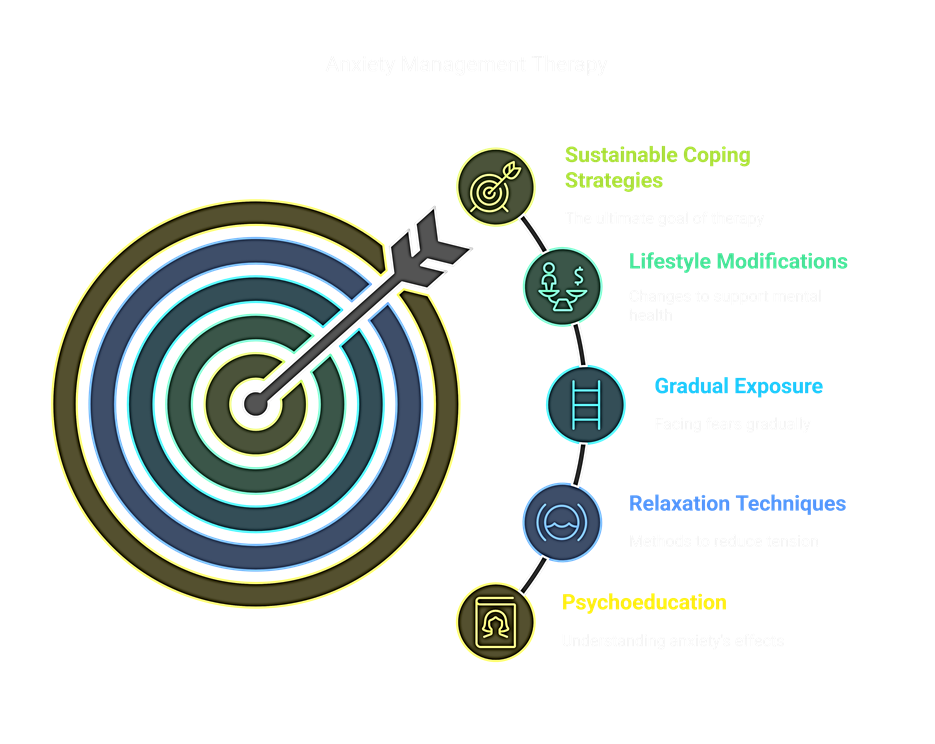
Understanding Your Anxiety: You’ll learn to recognize how anxiety affects both your body (like racing heart, sweaty palms) and your mind (like worry thoughts, feeling of doom). By becoming aware of these signs, you can catch anxiety early before it overwhelms you.
Changing Thought Patterns: Our thoughts strongly influence our feelings. For example, thinking “I’m going to fail this test and everyone will think I’m stupid” naturally leads to anxiety. In therapy, you’ll learn to question these thoughts and replace them with more realistic ones like “This test is just one assignment, and I’ve prepared as best I could.”
Relaxation Techniques: Your body can’t be relaxed and anxious at the same time. You’ll practice methods like:
• Deep breathing that signals your brain that you’re safe
• Progressive muscle relaxation where you tense and release different muscle groups
• Mindfulness, which helps you stay in the present moment instead of worrying about the future
Facing Fears Gradually: Avoiding things that make you anxious might feel better in the short term, but it actually makes anxiety stronger over time. In therapy, you’ll create a “ladder” of situations that cause anxiety, starting with easier ones and working your way up as you build confidence.
Lifestyle Changes: Simple things like getting enough sleep, cutting back on caffeine, exercising regularly, and spending time with supportive people can significantly reduce anxiety levels.
The therapists who provide this treatment might use approaches with names like Cognitive Behavioral Therapy (CBT), Acceptance and Commitment Therapy (ACT), or mindfulness-based therapies. All of these have been scientifically proven to help reduce anxiety.
Remember, the goal isn’t to eliminate anxiety completely—some anxiety is normal and even helpful. Instead, the aim is to keep anxiety at a manageable level so it doesn’t interfere with your life, relationships, and goals.
Research Review
Recent research indicates significant advances in anxiety management therapies. Cognitive-behavioral therapy (CBT) remains effective for various mental health issues, including anxiety disorders. Both online and app-based versions show promise (Nakao et al., 2021). Acceptance and Commitment Therapy (ACT) has demonstrated efficacy comparable to traditional CBT for anxiety and depression (Twohig & Levin, 2017; Beygi et al., 2023). Mindfulness-based interventions have also shown effectiveness in reducing anxiety symptoms (Hofmann & Gómez, 2017). Novel treatments such as transcranial magnetic stimulation and direct current stimulation show early promise for generalized anxiety disorder and social anxiety disorder (Lee & Stein, 2022). Internet-delivered CBT and digitalized mindfulness-based interventions are emerging as efficacious complements to face-to-face therapy (Apolinário-Hagen et al., 2020). However, more research is needed to establish long-term effects and comparative effectiveness of these approaches (Mangolini et al., 2019; Swain et al., 2013).
References Link:
Call to make an appointment with one of our therapists: (928) 641-8131
Contact us–We would like to hear from you.


 Mariposa Counseling Services LLC