
Couples Therapy
What is Couples Therapy?
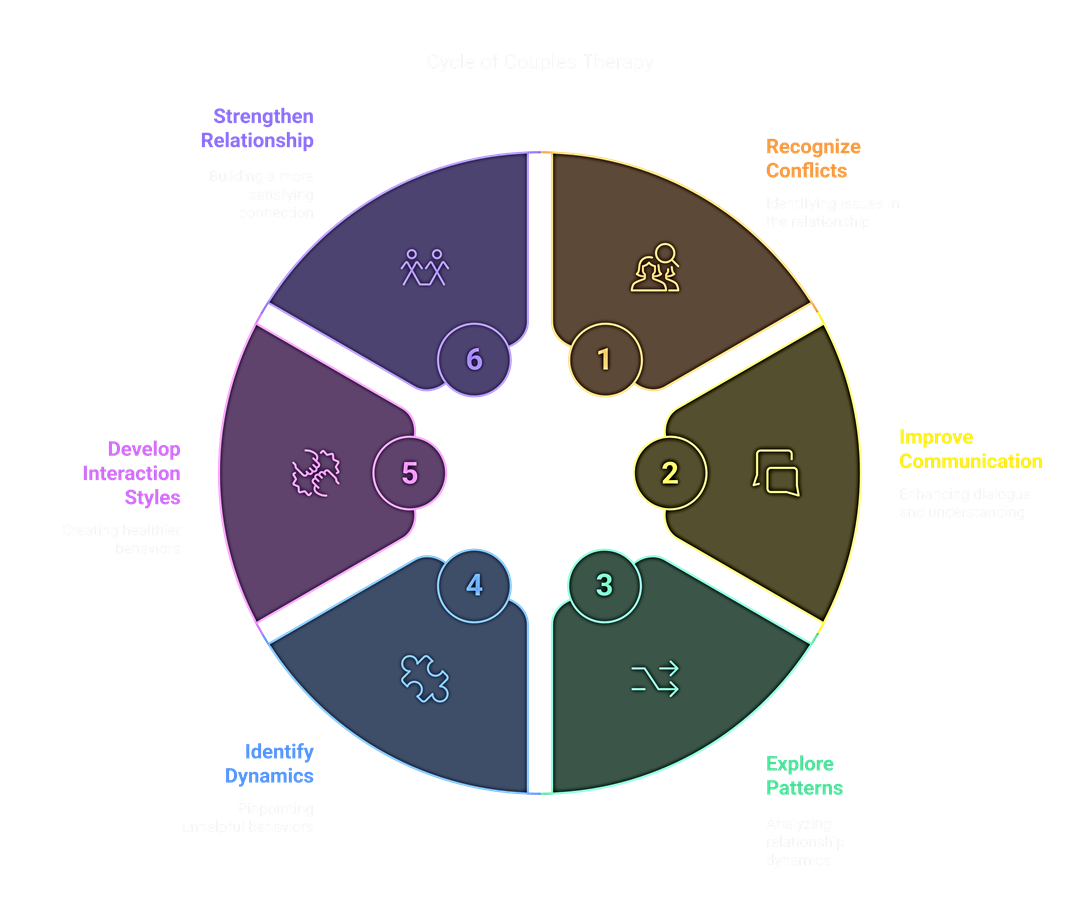
Couples therapy helps people in relationships work out their problems together. A special kind of counselor creates a safe space where both partners can talk about what’s bothering them.
What happens in couples therapy?
In couples therapy, partners learn to:
- Talk to each other better
- Understand why they keep having the same arguments
- Find better ways to solve problems together
- Feel happier in their relationship
Different kinds of couples therapy
Therapists use different methods to help couples:
Emotionally Focused Therapy (EFT) looks at how partners connect to each other. It helps them understand their feelings and needs better.
The Gottman Method teaches specific skills that make relationships stronger, like how to handle disagreements without hurting each other.
Imago Relationship Therapy helps partners see how things from their childhood might be affecting their relationship now.
How long does couples therapy take?
Some couples only need a few sessions to fix a specific problem. Others might go to therapy for many months to work on deeper issues.
What is the goal?
The main goal of couples therapy is to help the relationship become healthier. Sometimes couples decide to stay together after therapy, and sometimes they decide to break up. The therapist doesn’t try to force couples to stay together – they just help partners figure out what’s best for them.
Research Review
Recent research on couples therapy demonstrates its effectiveness in reducing relationship distress and improving overall relationship quality (Lebow et al., 2012; Lebow & Snyder, 2022). Emotionally Focused Therapy (EFT), an attachment-based approach, has emerged as a particularly promising method, showing positive outcomes in multiple studies (Wiebe & Johnson, 2016; Johnson et al., 2006; Johnson, 2019). EFT has been found to alleviate relationship distress and individual comorbidities, with lasting positive effects (Johnson, 2019). Process research on EFT has linked specific therapist interventions and client responses to treatment outcomes, informing clinical practice (Greenman & Johnson, 2013). The field of couples therapy has evolved to incorporate findings from attachment science, relationship research, and studies on individual disorders (Johnson, 2003; Snyder et al., 2006). Recent trends include the integration of telehealth technologies and the development of targeted treatments for specific problems and diverse populations (Lebow & Snyder, 2022).
Call to make an appointment with one of our therapists: (928) 641-8131.
Have a question or a request? Use the contact form below.


Our Latest Posts:
 Mariposa Counseling Services LLC